
Which HOWO Truck Model Is Best for Mining in East Africa?
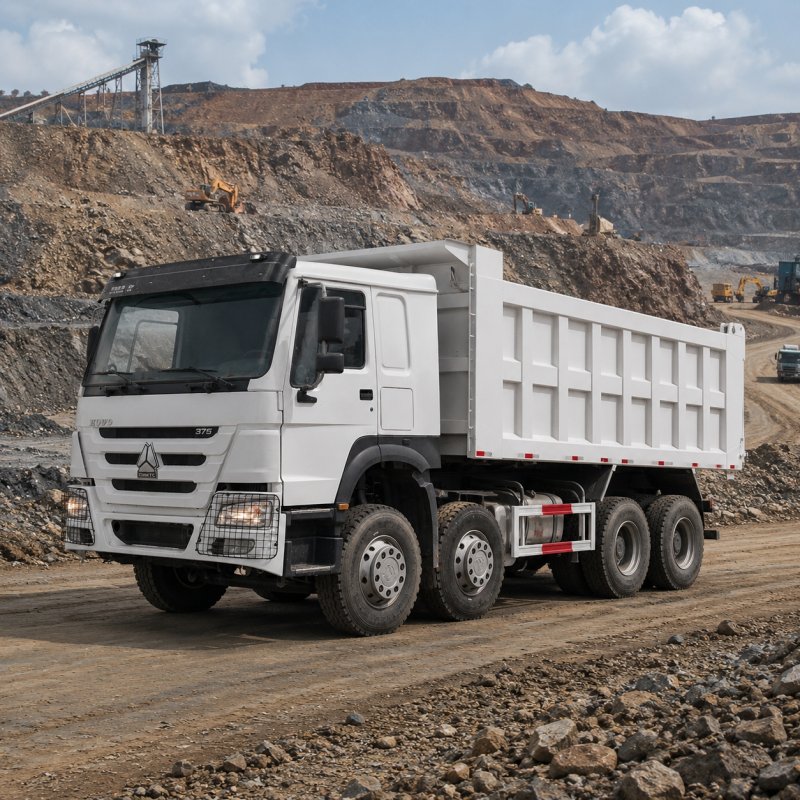
Which HOWO truck model is best for mining in East Africa? In most cases, the best choice is not one single model for every mine, but a match between haul distance, payload demand, road condition, and support capacity.
For short internal haul routes on rough mine roads, HOWO dump truck variants such as the HOWO 6x4 and 8x4 tipper are usually the strongest candidates. For moving materials or equipment between sites, HOWO tractor heads can be the better fit.
East African buyers also need to think beyond brochure payload. Reliability on steep gradients, parts availability, fuel consumption, axle strength, and ease of maintenance often matter more than headline specifications alone.
What is the best overall HOWO truck choice for East African mining?
If you want a practical short answer, the HOWO 6x4 dump truck is often the best overall starting point for many East African mining operations. It balances payload, traction, maintenance simplicity, and purchase cost better than heavier options.
For mines with higher daily production targets, wider haul roads, and stable loading areas, the HOWO 8x4 dump truck can deliver better tonnage per trip. That can improve output, but only if the road and loading conditions support the extra axle and weight.
In contrast, a HOWO tractor truck is usually not the first choice for direct pit hauling. It becomes more useful when your operation needs to move ore, aggregate, fuel, containers, machinery, or oversize loads between the mine and external destinations.
So when buyers ask, “which HOWO truck model is best for mining in East Africa?”, the most honest answer is this: choose a HOWO 6x4 for versatility, a HOWO 8x4 for higher-volume haulage, and a HOWO tractor head for logistics beyond the pit.
Why East African mining conditions change the truck selection process
Mining conditions in East Africa are demanding in ways that make model selection more important than in ordinary construction transport. The truck must perform under heat, dust, mud, steep access roads, and inconsistent maintenance environments.
In countries such as Kenya, Tanzania, Uganda, Zambia, and the Democratic Republic of the Congo, mine roads can vary sharply between seasons. A truck that looks ideal on paper may struggle when rain turns haul routes soft and uneven.
Fuel quality can also be inconsistent depending on location. That affects engine performance, injector life, and maintenance intervals. Buyers should favor proven configurations that local mechanics understand and local suppliers can support without long delays.
Distance from service centers is another major factor. In remote mining areas, the best truck is often the one your team can repair quickly with available filters, brake parts, suspension components, and drivetrain spares.
This is why mining buyers should avoid evaluating only rated horsepower or maximum payload. Operational uptime in local conditions is what determines whether a HOWO model actually creates value.
When a HOWO 6x4 dump truck is the smartest mining investment
The HOWO 6x4 dump truck is often the most practical option for small to mid-sized mining operations in East Africa. It works well where haul roads are narrow, turning areas are limited, and axle loading needs to stay manageable.
Its biggest advantage is versatility. A 6x4 tipper can handle overburden, ore, aggregate, and mine support tasks without requiring the wider operating space and stronger road base that an 8x4 typically prefers.
Another benefit is traction. On uneven surfaces or muddy grades, the 6x4 layout is often easier to manage than larger rigid configurations. That matters in quarries, open pits, and rural sites where road improvement may be limited.
From a cost perspective, the HOWO 6x4 usually offers a more accessible purchase price, lower tire expense, and simpler maintenance profile. That makes it attractive for operators focused on cost control and fleet flexibility.
It is especially suitable for mines that value dependable daily output over maximum per-trip capacity. If your route is rough and your cycle time depends more on road survival than absolute volume, the 6x4 is hard to ignore.
When a HOWO 8x4 dump truck makes more sense
The HOWO 8x4 dump truck becomes a strong option when production volume is high and the site infrastructure is better prepared. It is usually more appropriate for larger operations with established loading zones and maintained internal haul roads.
The main advantage is payload efficiency. With more carrying capacity per cycle, an 8x4 can reduce the number of trips required to move the same tonnage. That may lower labor cost per ton and improve loader-truck coordination.
However, those benefits only appear when the mine can support the truck properly. Soft ground, sharp turns, poor drainage, and weak haul roads can reduce the real productivity of an 8x4 and increase wear on suspension and tires.
Buyers should also think about loading compatibility. If your excavator or wheel loader consistently underloads the truck, the larger body may not produce the expected return. A bigger truck only pays off when the whole loading cycle supports it.
In short, the HOWO 8x4 is a productivity tool for mines with stronger operational discipline. It is not automatically the best mining truck just because it carries more.
Where HOWO tractor heads fit in mining operations
Many buyers focus only on tippers, but HOWO tractor heads also have a clear role in East African mining. They are valuable for regional transport, heavy equipment movement, fuel logistics, and long-distance ore or concentrate hauling.
If a mine operates across multiple sites or ships processed material to depots, ports, or plants, a HOWO tractor with the right trailer can be more efficient than keeping all transport tasks on dump trucks.
Tractor heads also allow more transport flexibility. Depending on the trailer setup, one unit can haul machinery today, bulk material tomorrow, and containers or fuel tanks on another schedule.
This makes them especially relevant for contractors and mine service companies. If your business supports multiple industrial clients, a HOWO tractor head can create wider utilization than a dedicated site tipper.
Still, for direct in-pit work on rough haul roads, dump trucks remain the more natural fit. Tractor trucks are strongest when the mining operation extends into broader transport and supply chain needs.
How to choose based on mine type and haul task
The right HOWO model depends heavily on what kind of mining activity you run. A stone quarry, gold mine, coal site, copper operation, and construction-material pit may all need different truck configurations even within the same region.
For short-haul quarry work with frequent loading cycles, a HOWO 6x4 tipper is often enough. It keeps movement agile and suits repeated loading and dumping on compact sites.
For larger open operations with higher stripping volumes, an 8x4 can provide better fleet efficiency, assuming roads and maintenance standards are strong. In these settings, tonnage per cycle matters more.
For inter-site material transfer or supply runs between the mine, town, and processing facility, a HOWO tractor truck paired with the correct trailer usually performs better than forcing a tipper to do logistics work.
Buyers should define the task first, then choose the model. Too many truck purchases fail because the selection starts from price or availability instead of actual haul duty.
What buyers should check before purchasing a HOWO mining truck
Before buying, start with payload reality rather than advertised capacity. Ask what the truck will carry every day, on what road, across what distance, and under what loading method. Those four answers usually narrow the right model quickly.
Next, inspect the chassis, axles, suspension, and body build quality. For mining duty, these components matter more than cabin cosmetics or marketing claims. Reinforced structures and proven driveline parts reduce downtime in harsh service.
Engine and gearbox configuration also deserve close attention. A truck that is underpowered for steep grades will burn more fuel and strain components. A truck that is badly matched to route speed can also raise maintenance cost.
Do not ignore parts support. Confirm whether filters, brake linings, clutch parts, leaf springs, injectors, and differential components are available in the local market. Fast parts access often matters more than a slightly lower purchase price.
Finally, evaluate after-sales support. A dealer or supplier who can provide technical guidance, warranty clarity, and practical spare parts planning will usually save more money over time than a seller focused only on the initial deal.
How fuel economy and maintenance affect real mining cost
In mining, the cheapest truck to buy is rarely the cheapest truck to own. Fuel burn, tire wear, downtime, and spare part replacement can quickly change the economics of a fleet decision.
A HOWO 6x4 may produce lower daily tonnage than an 8x4, but it can still deliver better cost per productive hour if the larger unit spends more time stuck, overloaded, or waiting for repairs.
Maintenance planning is especially important in East Africa because remote mines cannot afford long delays. A model with straightforward service needs and familiar components can keep operations moving even with limited workshop capacity.
Fuel efficiency also depends on matching the truck to the route. Over-specifying a truck for a light or moderate duty cycle can waste fuel. Under-specifying it can lead to constant strain and higher repair frequency.
The best HOWO truck model is therefore the one that produces stable output at a predictable operating cost. That is a more useful benchmark than simply chasing maximum payload.
Common mistakes when choosing a mining truck in East Africa
One common mistake is buying the largest truck available without checking road conditions. Bigger trucks can look attractive in sales discussions, but weak haul roads and tight site layouts often erase the productivity advantage.
Another mistake is overlooking service support. Even a strong truck becomes a liability if basic parts take weeks to arrive or local technicians are unfamiliar with the configuration.
Some buyers also treat mining and construction duty as identical. In reality, mining puts heavier, more repetitive stress on the frame, suspension, tires, and drivetrain. The truck should be specified for that workload from the start.
Price-only buying is another risk. A lower acquisition cost can hide higher spending on fuel, tires, breakdowns, and lost production. Serious buyers should calculate operating value, not just invoice value.
Finally, many fleets fail because they do not align truck choice with loading equipment. If the loader, excavator, road width, and dump cycle are mismatched, even a good HOWO model will underperform.
Final recommendation for East African buyers
If you are choosing one general-purpose mining truck for East African conditions, the HOWO 6x4 dump truck is usually the safest and most practical recommendation. It offers a strong balance of toughness, maneuverability, affordability, and serviceability.
If your mine has better roads, larger production targets, and the workshop capacity to support heavier units, the HOWO 8x4 dump truck can deliver higher volume and better cycle efficiency. It works best in more organized haul environments.
If your operation includes regional transport, equipment movement, or external logistics, a HOWO tractor head should be part of the evaluation. It fills a different role and can add major value beyond pit hauling.
So, which HOWO truck model is best for mining in East Africa? For most buyers, start with the HOWO 6x4, move to the HOWO 8x4 when volume and road conditions justify it, and choose a tractor head when mining transport extends beyond the site.
The best purchase decision comes from matching the truck to the mine, not from choosing the biggest specification. That is what protects uptime, controls cost, and improves long-term productivity.
Please give us a message
Our engineers help you choose the right truck or trailer based on:
- Your cargo type
- Road condition
- Payload requirement
- Local regulations