
What Is the Difference Between a Flatbed and a Lowbed Semi Trailer?
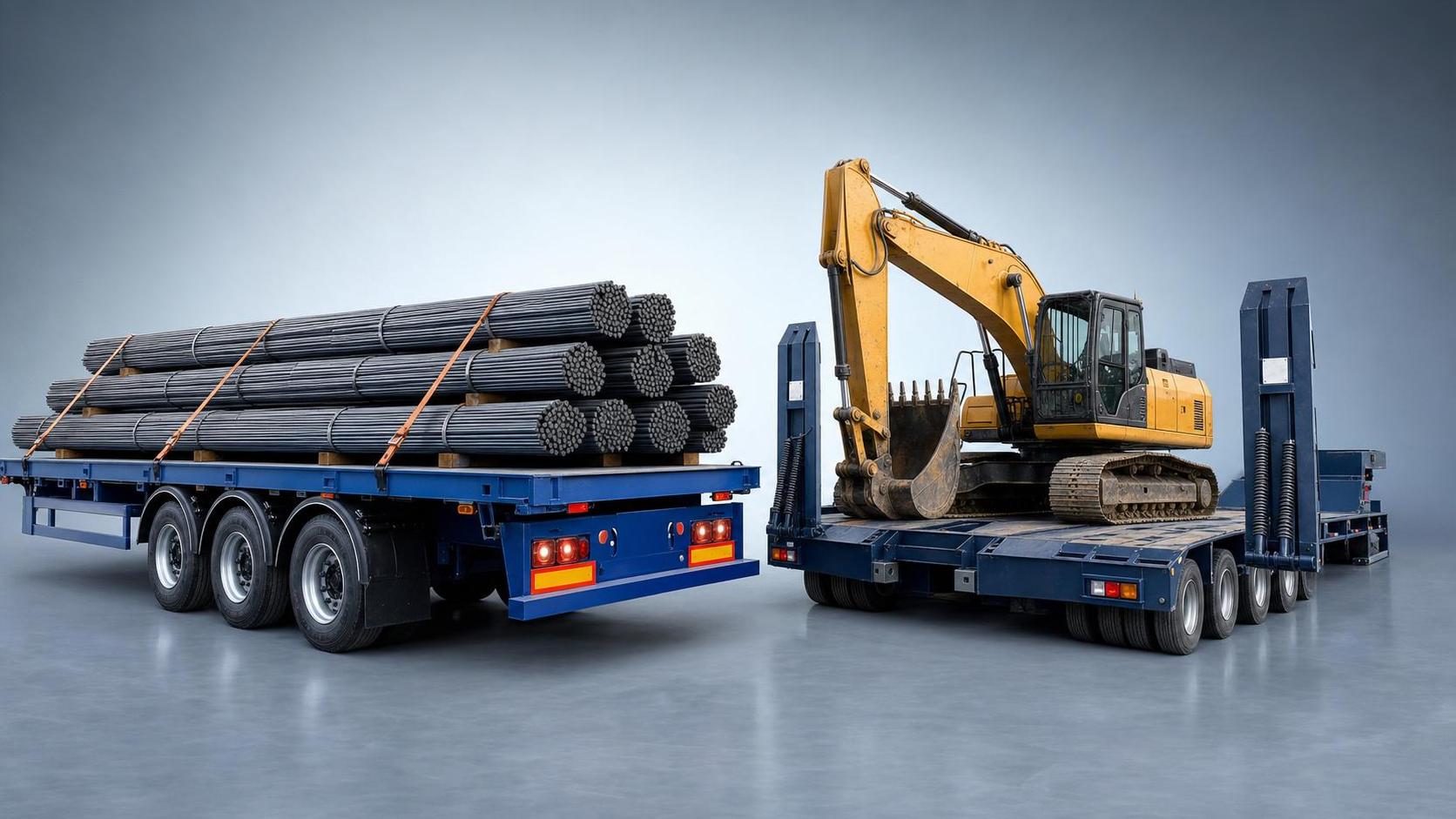
If you’re wondering what is the difference between flatbed and lowbed semi trailer options, the answer goes far beyond appearance. These two trailer types are built around different transport problems. One is meant to carry cargo that can sit high and wide on a simple open deck. The other is designed for loads that would be unsafe, unstable, or even illegal on a standard-height platform. That distinction affects route planning, loading method, axle configuration, permits, and total operating cost.
In day-to-day transport work, people sometimes reduce the comparison to “flatbed for regular cargo, lowbed for heavy equipment.” That is directionally true, but it leaves out the details that actually matter when a dispatch team, fleet manager, or buyer has to choose the right trailer. Deck height, center of gravity, approach angle, cargo dimensions, and ground clearance all change the decision.
The core difference is deck height and what that means in practice
A flatbed semi trailer has a relatively straight, level deck above the wheels. It is open, versatile, and easy to load from the side, rear, or top, depending on the freight and the available equipment. This makes it common for steel, timber, palletized cargo, pipes, containers in some applications, and construction materials that do not need an enclosed body.
A lowbed semi trailer, often called a lowboy in some markets, drops the deck height significantly compared with a standard flatbed. The cargo deck sits lower to the ground, usually between the gooseneck and the rear axle group. That lower loading platform is the whole point: it allows taller and heavier machinery to be carried with better stability and a better chance of staying within legal height limits on public roads.
So when people ask what is the difference between flatbed and lowbed semi trailer designs, the real answer is this: a flatbed maximizes versatility, while a lowbed prioritizes heavy, tall, and concentrated loads that need a lower center of gravity.
Structure affects loading, not just carrying
The deck shape changes how freight gets onto the trailer. A flatbed is straightforward. Forklifts can approach from the side. Cranes can lift cargo directly onto the platform. For many industrial and building materials, that simplicity saves time at both ends of the trip.
Lowbed trailers are different. They are often selected for wheeled or tracked machinery such as excavators, bulldozers, rollers, or other self-propelled equipment. In those cases, loading is usually done by ramps or, on some designs, by detaching the gooseneck for front loading. That matters because not every jobsite has the space, surface condition, or loading equipment to handle the process easily.
This is where experience tends to matter more than brochure specs. A trailer may be technically capable of carrying a machine by weight, but if the machine has a poor approach angle, low ground clearance, or uneven track contact, loading onto the trailer can still be awkward or risky. With lowbeds, loading geometry is not a small detail.
Typical cargo: broad freight versus concentrated machinery
Flatbeds are common when the cargo is long, packaged, stackable, or crane-lifted. Think steel sections, rebar bundles, lumber packs, precast materials, industrial components, or general project cargo that does not exceed normal road height once loaded. They are also useful when freight dimensions vary from trip to trip and the operator needs one trailer to cover many jobs.
Lowbeds are more specialized. They are preferred for construction and mining equipment, large agricultural machines, transformers, and other heavy units with high point loads. A standard flatbed may have enough deck area for that kind of cargo, but area is not the real issue. Height and weight distribution are. Putting a tall excavator on a flatbed can push total loaded height too high for bridges, overhead lines, or local legal limits. Even before permits become an issue, the higher center of gravity can make transport less forgiving.
Weight capacity is only part of the decision
A common mistake is to compare trailers only by rated payload. In heavy haul work, axle layout and legal load distribution often matter just as much as the nominal capacity. Lowbed trailers frequently come with multiple axle options because heavy machinery creates concentrated loads that need to be spread across more points. That helps with road compliance and can reduce the stress on the trailer structure itself.
Flatbeds can also be built in heavy-duty configurations, so this is not a simple “one is strong, one is weak” comparison. The better question is whether the cargo load path matches the trailer design. A long but relatively uniform steel shipment and a compact tracked machine do not behave the same way on the road. The machine may create intense pressure in a smaller footprint, and that changes what kind of deck, cross-member strength, and axle support make sense.
Usually, if the freight is exceptionally heavy, checking only the trailer brochure is not enough. Operators also need to confirm tractor compatibility, kingpin load, local axle rules, and route restrictions.
Road height, permits, and route limitations often decide the answer
In real transport planning, legal height is often what pushes a job toward a lowbed. A machine that looks manageable in the yard can become a problem once you add trailer deck height and start checking bridges, toll structures, overhead signs, and utility crossings. That is why lowbeds are so common in equipment transport: they buy vertical clearance.
This does not mean a lowbed removes all permit concerns. Oversize and overweight rules vary by country and sometimes by state or province, and they can involve escort requirements, travel time restrictions, and approved routes. But lowering the deck can be the difference between a manageable permit move and a much more complicated one.
For routine freight, a flatbed is usually easier to operate because loading docks, forklifts, and tarping practices are already built around it. For abnormal loads, “easier” quickly changes meaning. A flatbed may be simpler to find, but it can become the more difficult choice once route engineering starts.
Cost is not just purchase price
Flatbeds are generally viewed as the more flexible asset. If a fleet wants one trailer type that can stay active across many categories of freight, flatbeds often make financial sense. They are easier to deploy in general cargo work, and downtime from specialization is less of a concern.
Lowbeds tend to involve a narrower use case, but the cost equation changes when the freight demands them. If using a flatbed creates repeated permit issues, loading delays, safety risks, or the need to disassemble equipment before transport, the “cheaper” option may stop being cheaper. In heavy haul operations, the wrong trailer often costs money through time loss and risk exposure rather than through the invoice alone.
There is also the maintenance side. Lowbed trailers used in rough construction environments may see harder loading cycles, ramp wear, and higher structural stress around concentrated wheel or track loads. That does not make them inferior; it just means maintenance planning should reflect actual use conditions.
When a flatbed is the better choice
A flatbed usually makes more sense when the cargo is not especially tall, can be loaded from multiple sides, and changes frequently from shipment to shipment. It is often the practical option for carriers handling mixed freight where adaptability matters more than low deck height.
It is also a good fit when jobsite loading conditions favor forklifts or cranes rather than self-loading machinery. If the freight is palletized, bundled, or packaged in a way that benefits from quick access, the open and level deck saves labor. In those situations, a lowbed can feel like too much trailer for the job.
When a lowbed is the safer and more realistic option
A lowbed becomes the sensible choice when cargo height is close to road limits, when equipment must drive on and off the trailer, or when stability is a concern because the load is heavy and top-biased. That is especially true for excavators, loaders, cranes, and other machinery with significant mass above the deck line.
Another situation is when the cargo has poor transport geometry on a flat platform. Machines with tracks, attachments, or uneven weight balance may simply travel better on a lower deck built for that purpose. That is one of those details operators learn quickly in the field: technical compatibility on paper does not always translate into a smooth haul.
A few buying and planning mistakes to avoid
One mistake is choosing based on the heaviest possible load while ignoring the most frequent load. If 80 percent of your work is standard open-deck freight, a lowbed may sit idle too often. The reverse is also common: buying a flatbed because it is familiar, then discovering that your equipment loads constantly run into height and loading issues.
Another mistake is focusing only on trailer type and not on the full transport setup. Ramp angle, deck length, axle count, suspension type, tire specification, and tractor match all affect performance. For cross-border or multi-region transport, local regulations may also shape the “right” answer more than the cargo itself.
And one practical reminder: attachments change everything. A machine that fits well on a lowbed in base form may become a different transport problem once buckets, booms, blades, or accessories are installed. Those details should be checked before a trailer is assigned, not after the truck arrives.
So, what is the difference between flatbed and lowbed semi trailer options?
The short answer is that a flatbed is a general-purpose open trailer for a wide range of cargo, while a lowbed is a purpose-built trailer for taller, heavier, and more demanding loads that need a lower deck. The more useful answer is that the difference shows up in every practical part of transport: how you load, how stable the cargo sits, what routes are available, whether permits become harder, and how much operational compromise you are willing to accept.
If the load is regular freight, a flatbed is usually the cleaner and more economical tool. If the load is machinery, heavy equipment, or anything close to height limits, a lowbed is often the trailer that makes the move realistic in the first place. The right choice usually becomes obvious once you stop looking only at trailer shape and start looking at the cargo, route, and loading conditions together.
Please give us a message
Our engineers help you choose the right truck or trailer based on:
- Your cargo type
- Road condition
- Payload requirement
- Local regulations