
How Much Does a Fuel Tanker Trailer Cost in Africa in 2026?
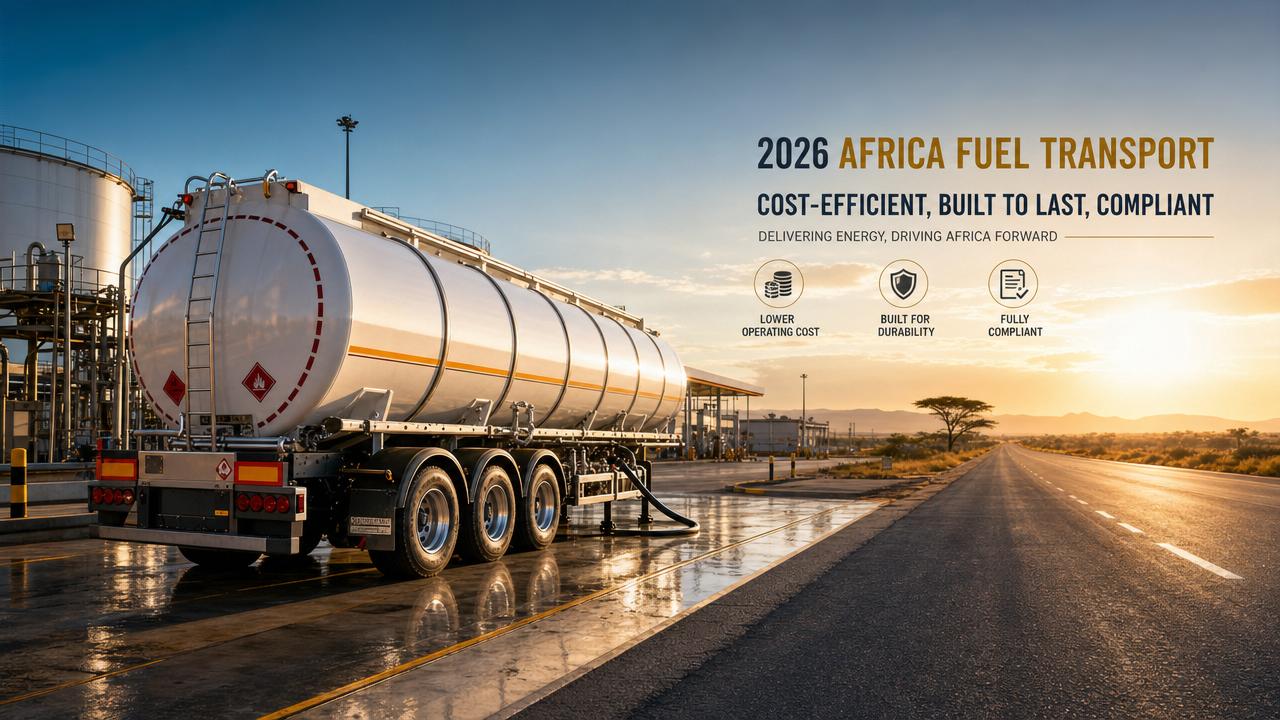
Fuel tanker trailer cost in Africa in 2026: why the answer changes by use case
How much does a fuel tanker trailer cost in Africa in 2026? The real answer depends on operating conditions, compliance targets, and total lifecycle cost.
A fuel tanker trailer serving urban stations faces different demands than one moving diesel across mining corridors or border routes.
That is why fuel tanker trailer cost in Africa is never a single number. Capacity, steel grade, axles, braking systems, and documentation all shape pricing.
In 2026, rising freight demand, stricter safety checks, and currency pressure will keep buyers focused on value, not only the purchase price.
This guide breaks the topic into practical transport scenarios, helping compare options and avoid expensive specification mistakes.
When pricing shifts: the operating scenario matters more than the headline quote
A basic quote may look attractive, yet it often excludes accessories, customs duties, local registration, and mandatory safety equipment.
For this reason, fuel tanker trailer price in Africa should be reviewed against the route, cargo type, loading frequency, and road quality.
Typical 2026 price ranges often fall between USD 28,000 and USD 75,000, depending on build quality and configuration.
Entry-level models usually cover simpler regional work. Premium units cost more because they support better durability, safer unloading, and easier compliance.
Imported trailers may carry higher landed costs. Locally assembled units may reduce lead time, but quality consistency must be verified carefully.
Core price drivers in 2026
- Tank capacity, such as 30,000L, 40,000L, 45,000L, or 60,000L
- Material choice, including carbon steel, aluminum alloy, or stainless steel sections
- Axle count and suspension type for rough roads or heavy loading
- Safety systems like bottom loading, vapor recovery, ABS, and emergency valves
- Import duty, inland delivery, homologation, and local certification fees
Scenario one: supplying urban fuel stations with frequent short-haul trips
Urban distribution needs reliable compartment layouts, smooth discharge, and safe maneuverability in tighter roads and station yards.
In this scenario, a fuel tanker trailer cost in Africa may stay in the mid-range because extreme off-road reinforcement is less critical.
Common specs include 30,000L to 45,000L tanks, three axles, multiple compartments, and quality piping for gasoline, diesel, or kerosene separation.
Estimated 2026 pricing often lands around USD 32,000 to USD 52,000, depending on local regulations and unloading features.
What matters most in city delivery
- Compartment customization for different fuel grades
- Stable braking response in stop-start traffic
- Reliable manholes, valves, and anti-spill design
- Fast discharge to reduce station turnaround time
Scenario two: moving fuel across long-distance highways and cross-border corridors
Long-haul transport changes the cost equation. Durability, axle loading balance, and tank stability become more important than low upfront price.
For these routes, fuel tanker trailer price in Africa usually increases because the trailer must handle heat, uneven roads, and extended travel hours.
Typical specifications include 45,000L to 60,000L capacity, reinforced chassis, stronger suspension, and upgraded tires suitable for regional corridors.
A 2026 buying range of USD 40,000 to USD 68,000 is common for higher-spec highway units.
If cross-border documentation is strict, buyers should also budget for compliance testing and approved safety labeling.
Why long-haul trailers cost more
Lower vibration damage means fewer leaks and less downtime. Better structural strength also improves resale value after years of service.
In some fleets, support equipment decisions align with other trailer assets, including units like 4 Axle 80Ton Flatbed Semi Trailer for mixed transport operations.
Scenario three: serving mines, farms, and remote industrial projects
Remote delivery conditions are harder on equipment. Gravel roads, overloading risk, and weak maintenance access all increase specification demands.
Here, fuel tanker trailer cost in Africa can rise sharply because ruggedness matters more than cosmetic finish or low manufacturing cost.
Common builds may include stronger leaf spring suspension, reinforced landing gear, protective piping placement, and thicker shell options.
Expected 2026 prices often range from USD 45,000 to USD 75,000 for remote-duty configurations.
A cheaper trailer may fail faster in these environments, creating losses through leakage, tire wear, and repeated workshop stops.
How different fuel transport scenarios change specification needs
Cost differences beyond the factory quote
Many buyers compare ex-works prices only. That approach can distort the real fuel tanker trailer price in Africa by a large margin.
The landed budget should include shipping, port handling, taxes, local inspection, registration, and optional insurance.
After delivery, operational costs continue through brake maintenance, tire replacement, seal changes, and periodic tank testing.
A slightly higher purchase price may still produce lower cost per kilometer over five years.
Checklist for real total cost
- Base trailer price
- Freight and customs charges
- Safety accessories and documentation
- Spare parts availability
- Expected maintenance frequency
- Resale potential after service life
Practical specification advice for matching trailer cost to route conditions
If routes are smooth and load cycles are frequent, prioritize discharge efficiency and compartment accuracy rather than maximum shell thickness.
If routes include long distances, seek reinforced frames, quality axles, and dependable braking systems before choosing decorative upgrades.
If roads are harsh, stronger suspension and protected under-run components will matter more than a low quote.
For mixed fleet planning, comparing tanker units with support assets such as 4 Axle 80Ton Flatbed Semi Trailer can improve utilization planning across transport operations.
Common mistakes that make a fuel tanker trailer seem cheaper than it really is
One mistake is buying oversized capacity for routes with weight restrictions. More liters do not always mean better profitability.
Another mistake is ignoring local certification requirements until the trailer arrives. Delays can add storage fees and idle capital costs.
Some buyers also underestimate the impact of poor valve quality, weak welding, or limited spare parts support.
In 2026, fuel tanker trailer cost in Africa should be judged by uptime, compliance readiness, and operating safety, not only invoice value.
Next-step actions before requesting a 2026 fuel tanker trailer quote
Start by defining the transport scenario clearly. List route length, fuel type, target volume, road quality, and local compliance requirements.
Then request quotes with the same technical basis, including tank volume, material, axle brand, tire specification, and safety system details.
Ask for a full landed-cost estimate, not only the factory number. Confirm warranty coverage and spare parts lead time.
The best fuel tanker trailer price in Africa is the one that fits the route, meets regulations, and protects long-term transport efficiency.
With a scenario-based comparison, 2026 purchasing decisions become more accurate, safer, and more profitable.
Please give us a message
Our engineers help you choose the right truck or trailer based on:
- Your cargo type
- Road condition
- Payload requirement
- Local regulations