
Why Did Chad Client Order Lowbed Trailers for CAT Excavators?

Facing remote sites, poor roads and heavy loads, a Chad client chose lowbed trailers to move CAT excavators efficiently and compliantly. This decision reflects practical needs (oversized load capacity, low center of gravity for safe transport, and simplified loading of bulky CAT excavators), as well as cost and regulatory considerations in Chad's transport environment. In the following article we'll explore the logistical challenges, trailer specifications, route planning and economic benefits that made lowbed trailers the best solution for transporting CAT excavators across Chad's demanding terrain.


What is a lowbed trailer and why it suits CAT excavators
Definition and key advantages
A lowbed trailer (low-loader) is a heavy-equipment transport platform with a lowered deck height, typically in the range of 0.9 m–1.4 m for common configurations. Lower deck height reduces the overall transport height of an oversized machine, improves stability by lowering the center of gravity, and simplifies loading using ramps or detachable goosenecks. For CAT excavators and similar machines that commonly weigh 15 t–60 t per unit, these features translate into safer transit and fewer permit complications compared with taller trailers.
Beyond deck height, lowbed trailers usually provide 2–6 axles with gross vehicle weight ratings in typical ranges of 30 t–80 t depending on configuration. Multiple axle options enable operators to distribute a CAT excavator's concentrated track or tire loads to meet axle load limits on unpaved or semi-paved rural roads, which is a frequent requirement along routes in Chad.
Operationally, loading time and ground clearance matter: lowbed designs can reduce loading/unloading time by 20%–40% in field conditions because ramps and deck layout accommodate excavator swing radii and boom footprint. For B2B decision-makers in transport and construction logistics, those time savings convert directly to lower site downtime and fewer handling risks.
Logistical challenges in Chad and scenario-based analysis
Terrain, road quality and distances
Chad's transport corridors mix paved highways and long stretches of secondary gravel or laterite roads. Typical project hauls to remote sites can be 50 km–600 km each way. On poor-surface sections, permitted axle loads often fall to lower practical thresholds, so selecting a trailer with adjustable axle configuration (3–6 axles) and load distribution options is critical to avoiding fines and road closures during the rainy season when unpaved surfaces deteriorate rapidly.
Environmental and seasonal factors add variability: peak wet-season softening can reduce allowable operating windows to 2–4 weeks in certain corridors, and bridge load limits may require route detours that extend distance by 10%–40%. These constraints drive the selection of trailers that balance compact transport dimensions with high gross-combined-weight capability.
Operationally, typical project teams need to plan 3 stages for heavy-equipment moves: pre-assessment (site and route survey), permitted transit (permits and escorts), and on-site handling (loading/unloading and stabilization). Each stage usually requires 5–15 working days depending on permit complexity and access conditions.
Technical specifications and selection checklist
Key trailer parameters to verify before purchase
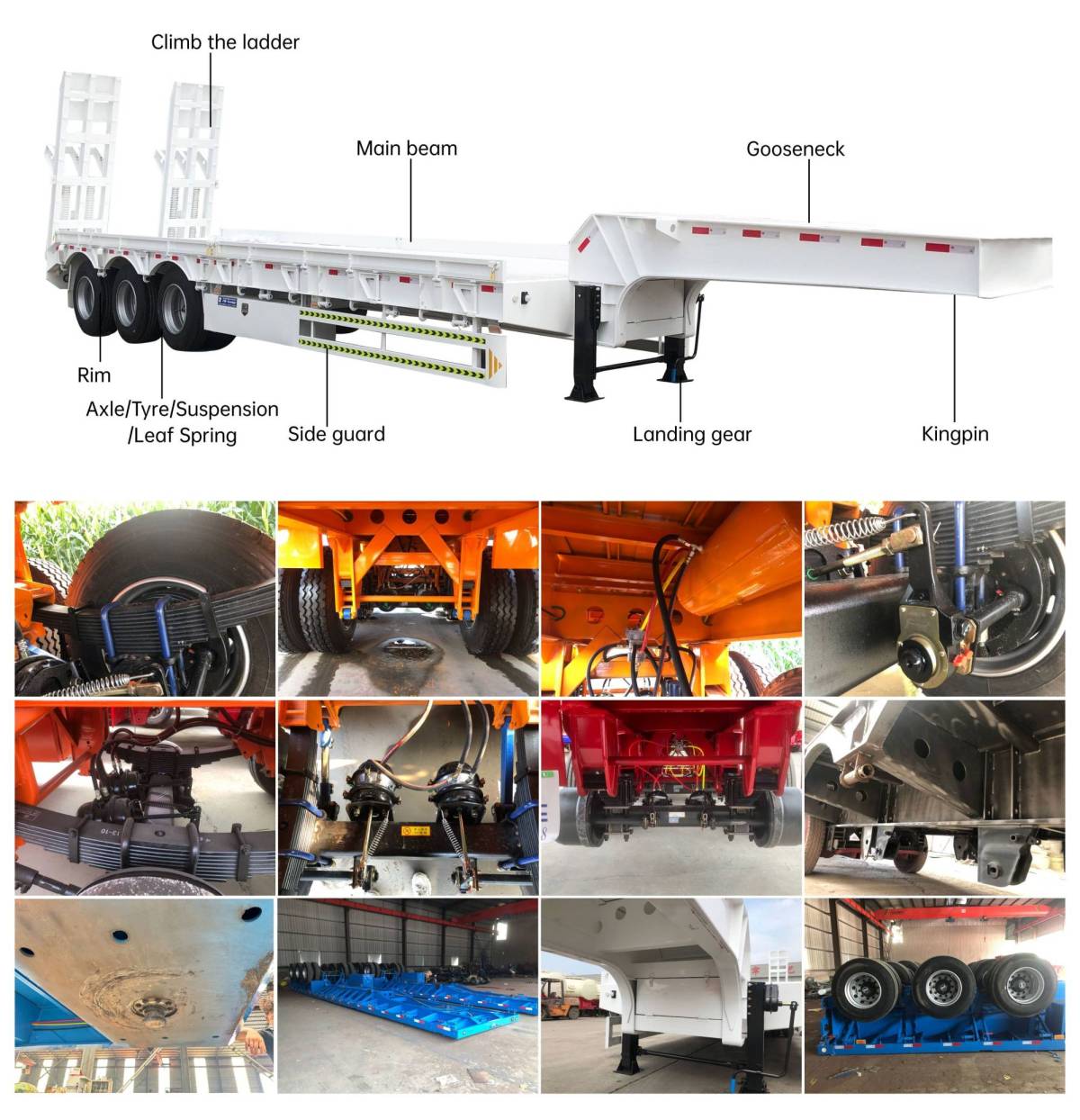
When selecting a lowbed trailer for CAT excavators, procurement teams should focus on 3 core indicators: usable deck length and width, axle count and spacing, and rated load capacity. Deck height, ramp angle and steerable/offset axle options matter for loading geometry and maneuvering through narrow approaches. Typical usable deck widths for excavator tracks are 2.5 m–3.0 m and deck lengths commonly range from 6 m–12 m depending on whether the boom or undercarriage will overhang.
Before presenting the parameter table, note that typical delivery lead times for custom-configured lowbed trailers are 4–8 weeks for standard builds and 8–16 weeks for heavily customized specifications (axle steering, hydraulic ramps, reinforcement plates). Warranty and after-sales service response windows of 7–15 days for spare parts logistics are practical expectations in regional operations.
The following table compares representative technical parameters for three common lowbed configurations used to transport 20 t–55 t CAT excavators.
Interpretation: for CAT excavators in the 20 t–35 t band, a 3-axle lowbed often suffices if route axle limits exceed 9 t per axle; for larger excavators 35 t–55 t, a 5-axle configuration spreads loads to meet bridge and road limits. Ramp angle and deck height influence loading safety, especially on soft ground where approach angles must stay within 8°–15° to prevent ground gouging.
Route planning, permits and compliance comparison
Permits, escorts and route risk matrix
Transporting oversized CAT excavators across Chad typically requires coordination with local authorities for movement windows, especially for loads exceeding 3.0 m width or 4.2 m overall height. Permit processing time commonly ranges from 3 days to 2 weeks depending on district rules. Additionally, police escort requirements and rolling road closures may be imposed for moves over 20 km in length in congested or urban-adjacent corridors.
The table below contrasts common permit and route constraints when using lowbed trailers versus alternative options (standard flatbed and detachable gooseneck) and lists mitigation measures. Use this as a quick assessment during pre-mobilization surveys.
Interpretation: lowbed trailers reduce permit friction for height-sensitive lifts, and configurable axle counts provide flexibility to comply with bridge and road thresholds. Where permits still require escorts or temporary traffic control, factor in an additional 1–2 days per 100 km for planning and execution.
Procurement guide, cost drivers and practical alternatives
How to evaluate offers and avoid common procurement mistakes
Procurement teams should evaluate offers across 5 key dimensions: technical fit (3 core indicators earlier noted), total cost of ownership (purchase price + transport insurance + maintenance), delivery lead time, after-sales support network, and optional safety features (load restraining systems, hydraulic ramps, axle steering). Typical procurement timelines follow 4 steps: requirements definition (1–2 weeks), supplier shortlisting (1–2 weeks), technical validation and factory inspection (2–4 weeks), and final delivery coordination (2–6 weeks).
When clients consider fleet augmentation versus rental, cost breakpoints commonly occur: short projects under 3–6 months favor rental or leasing; sustained projects of 12 months or more usually justify purchase. For mixed-operations where you already run highway hauling and site dumping, integrating a complementary vehicle such as Shacman F3000 8×4 400HP Dump Truck into logistics chains can improve mobilization speed and provide on-site hauling support between assembly points.
Cost drivers to watch: 1) axle and suspension upgrades add 10%–25% to base price; 2) hydraulic ramp or detachable gooseneck options add 8%–18%; 3) factory-added safety features and spare-parts kits typically add 3%–6% but reduce downtime. Always request a 5–10 item spare-parts list and a 6–12 month parts availability commitment in writing.
Implementation checklist and execution flow
Operational steps for a typical heavy lift move
A standard implementation flow for moving a CAT excavator with a lowbed trailer includes 6 steps: site and route survey, permit application, mobilization of equipment and crew, loading and securing, transit with monitoring, and on-site placement and demobilization. Each move phase should have clear acceptance criteria and 4–6 inspection checkpoints such as tie-down torque, ramp angle verification, axle load verification, and documentation of escort credentials.
- Pre-survey: measure approach slopes, verify ground-bearing pressure and record potential obstacles (3–5 data points).
- Permits: allocate 3–14 days depending on district complexity and load profile.
- Loading & securing: use rated chains and turnbuckles with documented inspection before transit.
- Transit: schedule movements in 1–4 hour windows to avoid high-traffic periods and manage escorts.
- On-site placement: allow 1–2 hours for controlled off-loading and stability checks.
Risk mitigation tips: perform axle-load calculations for each route segment, prepare alternative routes that add no more than 30% distance, and always carry a contingency budget of 5%–12% of transport cost for permit delays, escort fees and unexpected re-routes.
FAQ — practical answers for procurement and operations
How do I choose between lowbed and RGN for a CAT excavator?
Answer: choose lowbed when overall height and loading simplicity are priorities and when route permits favor lower deck heights. Choose RGN (removable gooseneck) if the excavator requires very low loading angles and the site lacks ramp handling capability. Evaluate on three dimensions: permissible axle load per bridge, approach geometry (slope ≤ 15°), and lifting resources on site.
What is a reasonable delivery lead time and after-sales expectation?
Answer: expect 4–8 weeks for standard lowbed builds and 8–16 weeks for heavy customization. After-sales, require spare-parts lead times of 7–21 days for common consumables and documented service response time windows of 7–15 days for regional support. These timelines help plan projects with 1–3 months of lead planning.
What common mistakes increase transport risk?
Answer: common mistakes include underestimating axle-load distribution, neglecting ramp geometry, skipping a secondary route plan, and failing to arrange certified escorts where required. Each mistake can add 1–3 days of delay and increase cost by 5%–20% depending on remedial actions.
Why choose us and next steps to get a tailored solution
What we can help you with — concrete consult items
We provide targeted support for heavy-equipment moves in Chad and similar markets. You can consult us on parameter confirmation (deck length, axle count, ramp angle), product selection for specific CAT excavator models (20 t–55 t), delivery lead times (4–16 weeks), and customization options (hydraulic ramps, axle steering). We also assist with permit strategy and route surveys that typically follow a 3-stage process (survey, permit, mobilization) taking 2–6 weeks overall for most projects.
Actionable next steps: provide excavator model and gross vehicle dimensions, share intended route or approximate distance (km), and state whether site access requires low ramps or crane-assisted loading. Based on that, we will produce a short proposal within 3–5 business days including configuration options, estimated delivery window, and a parts/support plan for the first 12 months.
Consultation items available by request: parameter confirmation, product selection and quotation, lead-time and delivery coordination, bespoke trailer customization, compliance and permit liaison, sample parts support and spare-kit pricing. Contacting us with the excavator model and intended route delivers the fastest path to an accurate recommendation and cost estimate.
Please give us a message
Our engineers help you choose the right truck or trailer based on:
- Your cargo type
- Road condition
- Payload requirement
- Local regulations